


AI is changing how enterprise applications are built, enhanced and used. But turning AI's potential into secure, scalable, auditable and maintainable business solutions is proving considerably more challenging than creating an impressive prototype.
Artificial intelligence is transforming software development. Applications that once took weeks to prototype can now be created in minutes. AI can generate code, analyse information, answer questions and automate complex business processes.
Yet there is a significant difference between demonstrating what AI can do and deploying it successfully within a large organisation.
Enterprise applications must meet demanding requirements for security, scalability, reliability, maintainability, audit-ability and governance. They must integrate with existing systems, protect sensitive information and evolve as business requirements change.
AI doesn't remove these requirements. In many cases, it makes addressing them even more important.
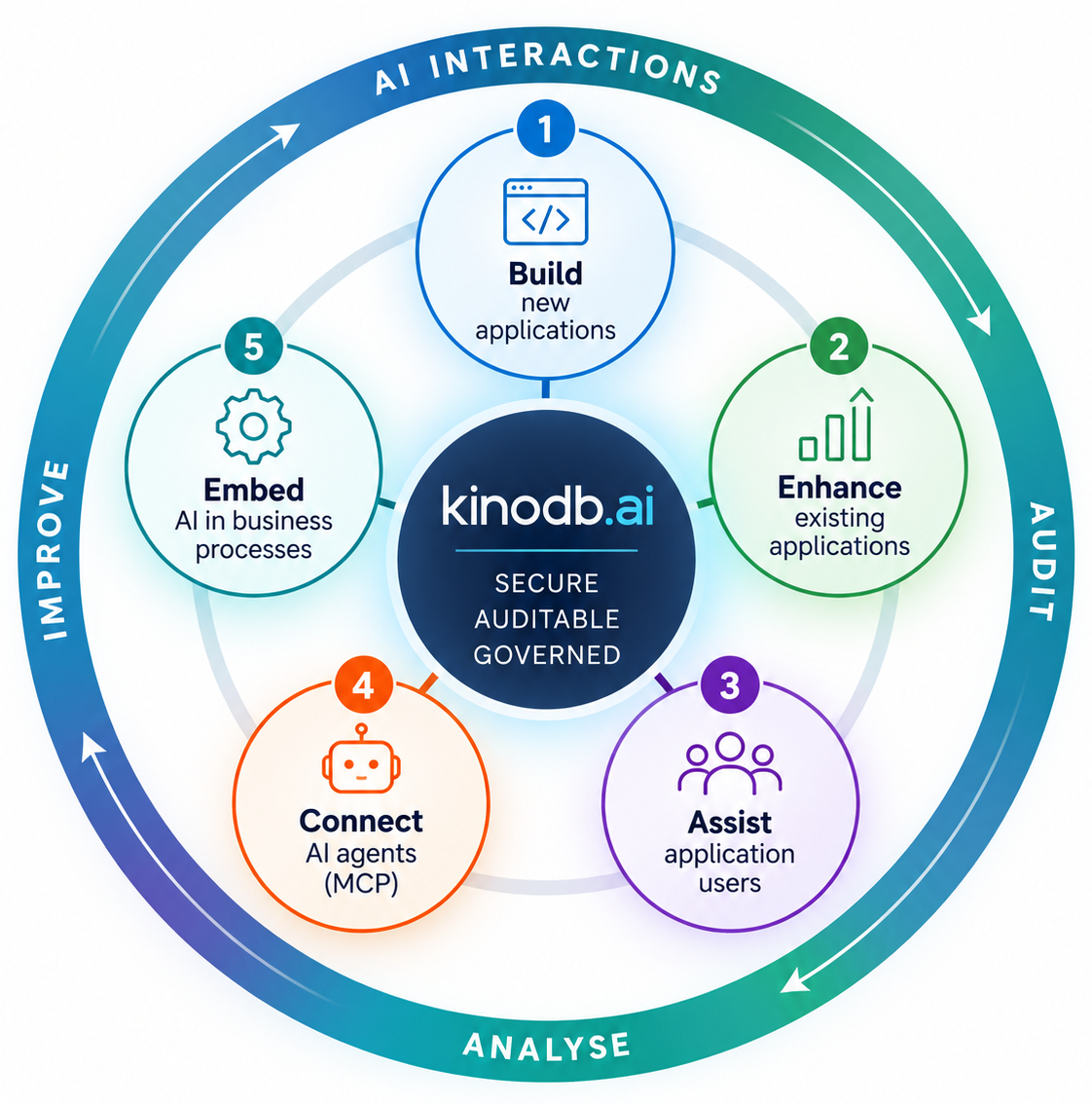
At datb, we see five primary ways AI can be used with enterprise applications and data.
- Building new applications
- Enhancing existing applications
- Assisting users within applications
- Allowing AI agents to interact with applications
- Embedding AI directly into business processes
Each offers significant opportunities. But each also introduces challenges that can be easily overlooked when moving from an impressive AI demonstration to a production enterprise system.
And there is another requirement that cuts across all five: governance and auditability.
If AI is going to become part of enterprise applications, organisations need to understand not only what it can do, but how it is being used, what information it is accessing and what it is producing.
Our metadata-driven enterprise application development and deployment platform, kinodb, has been designed to address these challenges at the platform level.
1. Building new applications with AI
AI has dramatically reduced the time required to create an application prototype.
Describe what you want, and an AI tool can generate database structures, application interfaces and working functionality remarkably quickly.
But a working prototype is not necessarily a production-ready enterprise application.
As applications become larger and more complex, challenges emerge. How do you ensure consistent security? How do you maintain the application as requirements evolve? How do you manage thousands of interconnected data structures and business rules? And how do you ensure the resulting application is robust, scalable and supportable?
These are challenges that AI-generated code alone does not necessarily solve.
The kinodb approach
kinodb takes a fundamentally different approach to application development.
Rather than generating an entire application as conventional program code, AI works with kinodb's metadata model, which defines the application's data structures, interfaces, security, business rules and behaviour.
This allows complex applications to be developed incrementally, breaking requirements into smaller, manageable components that AI can understand and modify.
Meanwhile, kinodb provides the underlying enterprise capabilities, including security, scalability, resilience, auditing and integration.
The result is that AI can concentrate on delivering business functionality, while the platform takes responsibility for the technical implementation..
This helps bridge the gap between rapid AI prototyping and production-ready enterprise applications.
2. Enhancing existing applications with AI
AI is extraordinarily good at generating code.
The more difficult problem is understanding an existing application.
Before making a change, AI may need to understand thousands of lines of code, database structures, dependencies, business rules and decisions made by developers years earlier.
Generating code quickly isn't particularly useful if significant human effort is then required to establish whether the change is correct and what else it might affect.
The kinodb approach
kinodb applications are defined using a structured, semantic metadata model.
Rather than requiring AI to interpret large volumes of conventional source code, kinodb provides a semantic representation of the application that describes its structure, relationships, rules and behaviour.
This gives AI a much clearer understanding of the application and the context in which changes need to be made.
The kinodb AI Development Assistant can use this information to help developers introduce new functionality, modify existing processes and extend applications.
Importantly, the same approach works whether the application was developed yesterday or decades ago.
AI becomes a tool for continuously improving existing applications, rather than simply generating new ones..
3. Giving application users their own AI assistant
Natural language is becoming an increasingly important way for people to interact with software.
Instead of navigating complex menus, constructing reports or learning how information is organised, users can simply ask questions.
For example:
- "Which projects are currently behind schedule?"
- "Show me all outstanding inspections for this asset."
- "Summarise the issues raised during the last month."
- "Which actions are assigned to me and overdue?"
The potential productivity benefits are substantial.
However, adding AI assistance to enterprise applications introduces an important challenge: the AI assistant must respect the same security and access controls as the application itself.
A user should not be able to obtain information through an AI assistant that they would not otherwise be authorised to access.
Retrofitting this capability into conventional applications can require substantial additional development and integration.
The kinodb approach
The kinodb AI User Assistant is provided as a capability of the platform itself.
Because kinodb already understands the application's metadata, data structures and security model, the assistant can operate within the individual user's existing access rights.
This provides a natural-language interface to the application without requiring developers to build a separate AI integration and security framework for every application.
Interactions with the AI assistant are also audited.
That audit trail is valuable for governance, but it can provide something equally important: insight into what users actually want from the application.
If users repeatedly ask the assistant for the same information, that may indicate an opportunity for a new report, dashboard, screen or workflow. If users struggle to find particular information, the application's user interface may need to change.
The AI assistant can therefore do more than help users operate the application. Its usage can help organisations understand how the application itself could be improved.
Perhaps most importantly, this capability is not restricted to newly developed applications.
A kinodb application originally developed more than 20 years ago can benefit from today's AI assistant technology through an upgrade to the underlying platform.
The application itself does not need to be rebuilt.
4. Connecting AI agents to enterprise applications
AI agents potentially take this another step further.
Instead of simply answering questions, an agent can perform tasks across multiple systems on a user's behalf.
That could produce dramatic improvements in productivity.
But an agent needs a way to communicate with each application.
Increasingly, that can be provided through the Model Context Protocol (MCP).
Creating an MCP interface is only part of the problem, however. Organisations also need to control exactly what each agent is permitted to see and do.
Otherwise, an AI integration risks creating a new backdoor into corporate information.
There is another architectural consideration too. Without well-designed interfaces, organisations could end up with multiple agents independently extracting, interpreting and processing the same information.
The kinodb approach
kinodb automatically provides an integration layer based on the Model Context Protocol (MCP), enabling AI agents to interact with applications through controlled interfaces.
Because this capability is generated from the application's metadata, developers do not need to create a separate integration layer for every application. It also means that applications built long before AI agents existed can be made accessible to them with a simple upgrade.
Access is governed through the application's established security model, controlling what individual agents are permitted to access and what actions they can perform.
Agent interactions with the application are audited.
This creates visibility into what agents are asking for, what information they are accessing and how the interfaces are being used.
Over time, that information can be analysed to identify common requests and usage patterns. Instead of repeatedly having agents perform complex sequences of interactions, these patterns could highlight opportunities to create better, more efficient application interfaces specifically designed to support them.
So the MCP layer doesn't just provide connectivity. It can create a feedback loop for continually improving how applications interact with AI agents.
5. Embedding AI directly into business processes
Some of the most valuable uses of AI may be the least visible.
Not every AI capability needs a chatbot or conversational interface.
AI can be embedded directly into existing business processes to perform tasks that would otherwise require manual effort or complex bespoke development.
Examples include:
- Document processing: Extracting and interpreting information from incoming documents.
- Information classification: Automatically categorising emails, reports and other content.
- Sensitive data protection: Identifying and redacting special category personal data.
- Summarisation: Producing concise summaries of lengthy documents, correspondence or case histories.
- Decision support: Analysing information and recommending actions for human review.
The challenge is ensuring that AI operates within clearly defined business rules and controls: When should AI be used? What information should it receive? What should it be allowed to do? And where should a human remain in the loop?
The kinodb approach
kinodb allows AI capabilities to be incorporated directly into application processes.
The application controls when an AI model is invoked, what information is provided, what task it is asked to perform and how the result is handled.
Where appropriate, human approval can remain part of the process.
This makes AI a controlled component of the application rather than an independent system operating outside established business processes.
And because the integration is managed through the platform, the same capabilities can be incorporated into existing applications.
Governance and auditing: essential for enterprise AI
Across all five use cases, one requirement is particularly important: organisations need visibility and control over how AI is being used.
When AI is generating application functionality, accessing business information or participating in operational processes, accountability matters.
kinodb provides auditing of AI interactions, helping organisations understand how AI capabilities are being used and supporting oversight of their operation.
This information can also provide valuable insights into how applications and their interfaces might be improved.
For example, analysing the questions users ask an AI assistant may reveal information that is difficult to find through the conventional application interface, or identify opportunities for new functionality.
In this way, AI can do more than improve productivity. It can help organisations understand how their applications are actually being used and where further improvements would deliver value.
The bigger picture: enterprise applications that never become legacy
There is a common theme running through all five AI use cases.
The real advantage comes from making AI a capability of the application platform, rather than something that must be individually engineered into every application.
This is particularly important when considering the long-term investment organisations make in enterprise software.
Over the past two decades, application technology has evolved enormously.
New requirements have emerged for authentication, security, integration, browser compatibility, cloud infrastructure and many other aspects of enterprise computing.
With conventional software, accommodating these changes can require substantial redevelopment, sometimes resulting in applications being replaced simply because their underlying technology has become obsolete.
kinodb was designed to avoid this problem.
Because applications are defined as metadata, independently of the underlying technology, the platform can evolve without requiring the applications themselves to be rewritten.
New capabilities such as multi-factor authentication, single sign-on, modern web services and now artificial intelligence can be introduced at the platform level and made available to existing applications.
An application developed more than 20 years ago can therefore benefit from modern AI capabilities while retaining its existing data, business rules and functionality.
AI is simply the latest technology evolution that kinodb has absorbed without requiring applications to be rebuilt.
This is what we mean when we say:
Applications built on kinodb never become legacy.
One platform. Five approaches to enterprise AI.
AI presents enormous opportunities for organisations to build applications faster, improve existing systems, empower users, automate processes and unlock greater value from enterprise data.
But realising those opportunities requires more than access to powerful AI models.
It requires an application architecture that provides the security, governance, scalability and maintainability that enterprise systems demand.
By combining AI with a metadata-driven development and deployment platform, kinodb provides a practical approach to adopting AI across the entire application lifecycle.
And crucially, organisations don't have to start again to benefit.
Interested in what AI could do for your enterprise applications?
At datb, we help organisations develop, enhance and maintain complex enterprise applications using kinodb.
Whether you're looking to build a new application, introduce AI into an existing system or explore how AI agents could work with your enterprise data, we'd be happy to demonstrate what's possible.
Contact datb to discover how kinodb can help you take advantage of enterprise AI, without creating tomorrow's legacy systems.


